
Sterile RTU Glass Vials
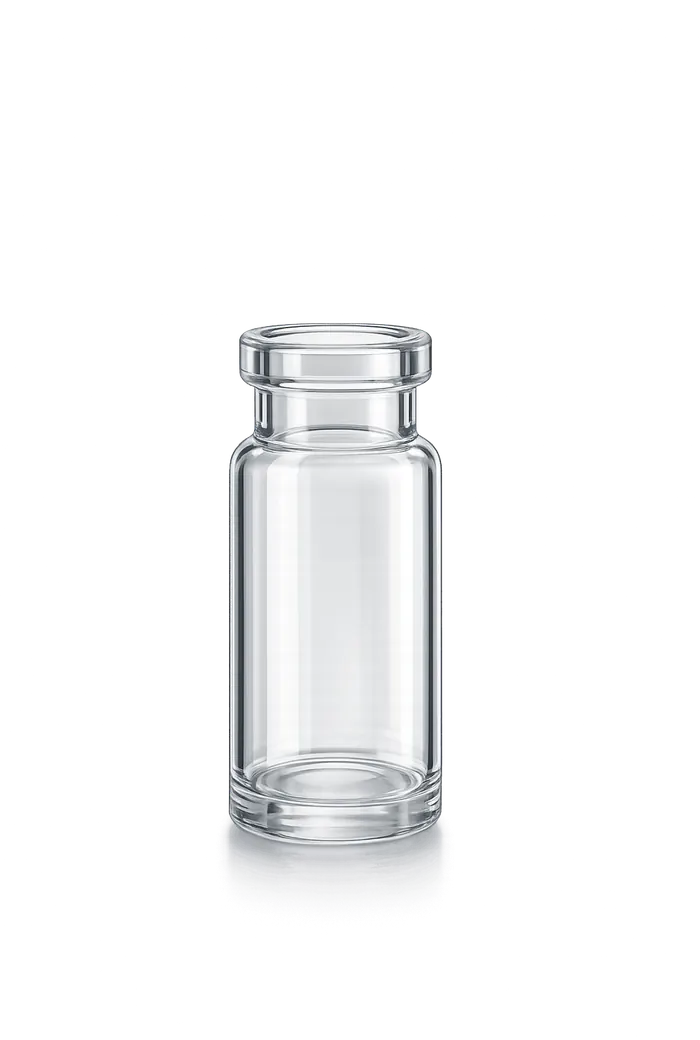
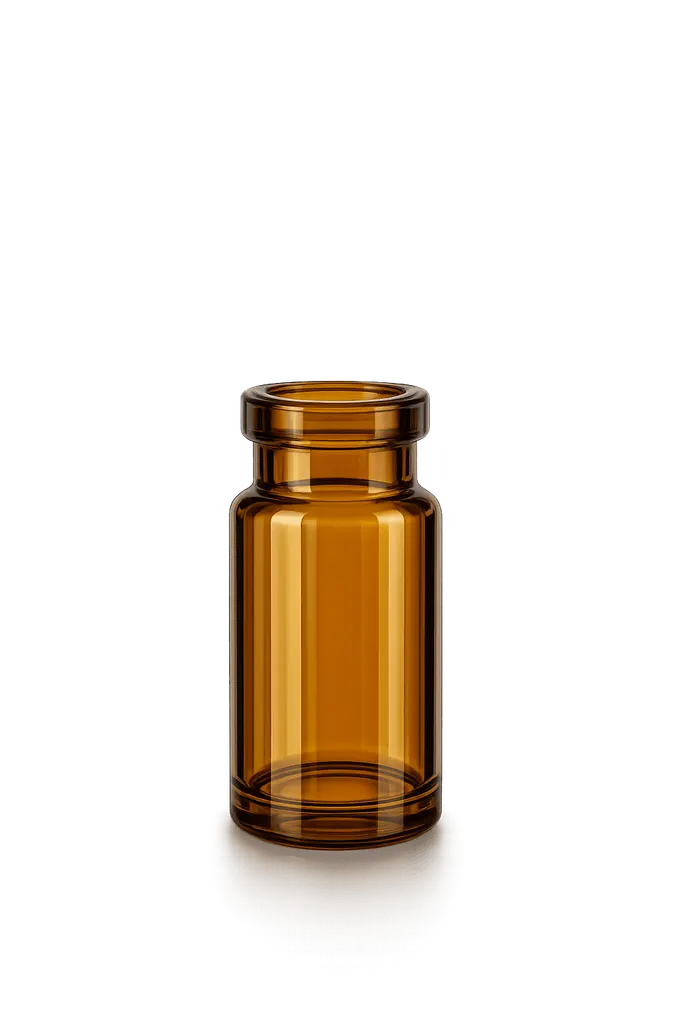
Sterile, depyrogenated, ready-to-use (RTU) Type I borosilicate glass vials that go straight from the tray to filling. Every size from 2R to 100R, independently tested for sterility and endotoxin, with documentation for every lot.
By the case · quoted for your volume
Net 30 once verified
Larger orders with a longer lead time
Compare vial sizes
Dimensions correspond to ISO 8362-1 tubular injection vials, and the final drawing is confirmed for each order. The neck finish decides which stopper and seal fit.
| Format | Nominal size | Neck & closures | Colors | Per tray · per case | Common use | |
|---|---|---|---|---|---|---|
| 2R | ~2 mL | 13 mm stopper and seal | Amber · clear | 125 · 2,000 | Single doses, small-volume preparations | SKUs |
| 6R | ~6 mL brimful ~8.5 mL · ~40 × 22 mm | 20 mm crimp neck | Amber · clear | 96 · 1,152 13,824 per pallet | Multi-dose preparations | SKUs |
| 10R | ~10 mL | 20 mm stopper and seal | Amber · clear | 77 · 924 | Larger multi-dose preparations | SKUs |
| 30R · 50R · 100R | ~30–100 mL | Confirmed at quote | Amber | Quoted | Large-volume and bulk preparations | SKUs |
Specifications, all formats
- Glass
- Type I (neutral) borosilicate tubing · inner surface HC1 · B2O3 ≥ 8%
- Dimensions
- Correspond to ISO 8362-1; drawing confirmed per order
- Amber
- Light-protective, >90% UV absorption (~290–450 nm)
- Clear
- For visual inspection of the contents
- Preparation
- WFI-washed, dry-heat depyrogenated, nested under Grade A air
- Sterilization
- Ethylene oxide, validated process · EO residue ≤ 1 µg/mL
- Endotoxin
- ≤ 0.5 EU/mL release specification · independent test <0.17 EU/vial
- Packaging
- Sterile trays in cases; 6R case 785 × 256 × 355 mm, 12 kg
- Minimum order
- 1 case, or a sample tray
- Ship time
- Varies by item, confirmed at order
Documentation
Choosing the right sterile vial
A ready-to-use (RTU) vial arrives washed, depyrogenated and sterilized, so it goes from the tray straight to filling. What you still choose is the size, the glass color and the closures that fit its neck.
RTU vs. bulk vials
Bulk vials must be washed, depyrogenated, sterilized and tested in-house before filling, with a validated process for each step. RTU vials remove that equipment, labor and validation work.
Type I borosilicate glass
Hydrolytic Class I glass resists chemical attack and leaching, which is why it is the standard for injectable preparations.
Amber or clear
Amber glass protects light-sensitive preparations, absorbing more than 90% of UV light (about 290–450 nm). Clear glass makes visual inspection of the contents easier.
Size and neck finish
The “R” number is the ISO 8362-1 format, roughly the vial’s nominal volume in mL. The neck finish decides which stopper and seal fit: 13 mm for 2R, 20 mm for 6R and 10R.
RTU vials: high quality, without the in-house prep cost
Our vials arrive sterile and depyrogenated, so there is no washing, depyrogenation oven or autoclave cycle before filling, and no in-house process to validate. That equipment, labor and validation time is where bulk vials get expensive; RTU vials remove it, at wholesale case pricing.
A lot of our sterile 6R amber vials was tested by Eagle Analytical Services, an independent laboratory in Houston, Texas, in June 2026, and passed both sterility and bacterial endotoxin testing.
Results apply to the lot tested. Every lot ships with its own Certificate of Analysis and sterility documentation; the full laboratory report is available on request.
| Test | Method | Result |
|---|---|---|
| Sterility | USP <71> / EP 2.6.1 · direct inoculation · 14 days | Pass |
| Method suitability | USP <71> · six challenge organisms | Compatible |
| Bacterial endotoxin | USP <85> component test | Pass · <0.17 EU/vial (<0.001 EU/mL) |
| Sample | 6R amber glass vial · lot 202603095 | June 2026 |
What every lot is tested for
Every lot is tested against the manufacturer’s release specification before it ships. Three consecutive qualification batches were tested in full, and all three conformed.
| Test | Acceptance criterion | Qualification batches (3) |
|---|---|---|
| Hydrolytic resistance, inner surface | Class HC1 | HC1 |
| Hydrolytic resistance, glass grains | Class 1 (121 °C) · HGB1 (98 °C) | Class 1 · HGB1 |
| Boron trioxide (B2O3) | ≥ 8% | 11% |
| Thermal expansion (20–300 °C) | 3.5–6.1 × 10⁻⁶ K−1 | 5.2 × 10⁻⁶ K−1 |
| Internal stress | ≤ 40 nm/mm | 2.05–2.21 nm/mm |
| Thermal shock | No breakage, 180 °C for 2 h | No breakage |
| Freeze–thaw | No breakage, 24 h at −41 °C then 40 °C water | No breakage |
| Sub-visible particles | ≥ 10 µm: ≤ 60 · ≥ 25 µm: ≤ 6 per vial | 40.6–43.4 · 2.1–4.2 |
| Ethylene oxide residue | ≤ 1 µg/mL | < 1 µg/mL |
| Bacterial endotoxins | ≤ 0.5 EU/mL | < 0.5 EU/mL |
| Sterility | No growth | No growth |
The manufacturer tests to Chinese national packaging standards (YBB) and the Chinese Pharmacopoeia. The technical dossier maps each test to its USP, Ph. Eur. and ISO equivalent (for example USP <660>, <71> and <85>); that mapping is a cross-reference, not a certificate of testing to those methods.
Prepared and packed for aseptic filling
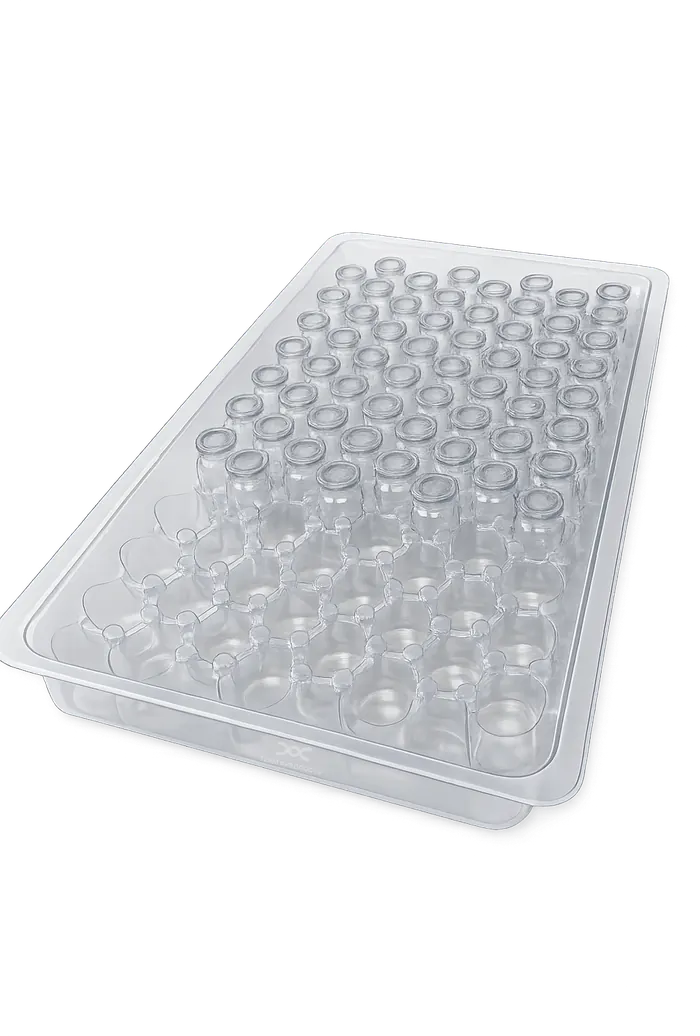
Washed with Water for Injection, depyrogenated in a dry-heat tunnel, nested in a sealed tub with a Tyvek® lid under Grade A air, double-bagged and ethylene-oxide sterilized. Open the tub only under ISO 5 conditions.
Stability data
All three qualification batches met every specification, including sterility and endotoxin, after 6 months accelerated (40 °C / 75% RH) and 9 months real-time storage. The real-time study continues to 36 months.
Glass compatibility
An extractables study in nine simulants (pH 2.5–10.5, citrate, glycinate, chloride, up to 15% ethanol) found no element above its ICH Q3D threshold and no delamination under USP <1660> stress conditions. Compatibility with your own formulation is still your assessment.
Stoppers and seals that fit every vial
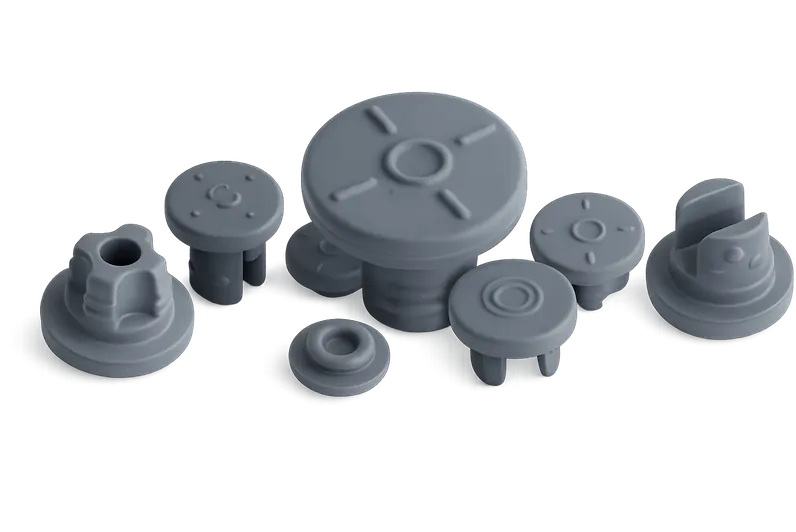
13 mm closures fit 2R vials; 20 mm closures fit 6R and 10R. Order the vial, stopper and seal together and we confirm the fit.
13 mm Lyophilization Stopper
T4P-STP-13-LYO-2L · Quote
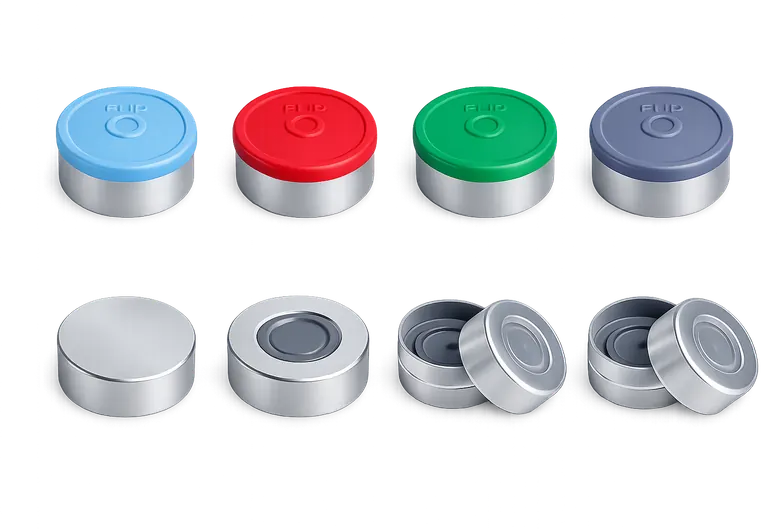
13 mm Flip-Off Cap · 4 colors
White, blue, red, yellow · Quote
View all →20 mm Lyophilization Stopper
T4P-STP-20-LYO-2L · Quote
20 mm Flip-Off Cap · 5 colors
White, blue, red, yellow, purple · Quote
View all →Vial questions
What vial size do I need?
Choose by fill volume: 2R (about 2 mL) for single doses and small volumes, 6R or 10R for multi-dose preparations, and 30R to 100R for large volumes. 2R vials take 13 mm closures; 6R and 10R take 20 mm.
What is an RTU vial?
An RTU (ready-to-use) vial is supplied already washed, depyrogenated and sterilized, so it goes straight to filling without in-house preparation. Team 4 Products supplies sterile, depyrogenated RTU Type I borosilicate glass vials from 2R to 100R.
Are Team 4 vials independently tested?
Yes. A lot of sterile 6R amber vials was tested by Eagle Analytical Services in Houston in June 2026 and passed USP <71> sterility and USP <85> bacterial endotoxin testing, at less than 0.17 EU per vial. Every lot also ships with its own Certificate of Analysis and sterility documentation.
Are RTU vials more cost-effective than bulk vials?
Usually, once preparation is counted. Bulk vials must be washed, depyrogenated, sterilized and tested in-house, with a validated process; RTU vials remove that equipment, labor and validation work. Send us your current vial price and we will quote against it.
Is documentation available for each lot?
Yes. A Certificate of Analysis and sterility documentation are available for each lot on request, along with the specification sheet and safety data sheet.
How are Team 4 RTU vials sterilized and packaged?
They are washed with Water for Injection, depyrogenated in a dry-heat tunnel, nested in a tub sealed with a Tyvek® lid under Grade A air, double-bagged and sterilized with a validated ethylene oxide process. Ethylene oxide residue is limited to 1 µg/mL or less.
Are the vials suitable for peptide and GLP-1 preparations?
The glass was tested in an extractables study across nine simulants from pH 2.5 to 10.5, with no element above its ICH Q3D threshold and no delamination under USP <1660> stress conditions. That supports, but does not replace, your own compatibility assessment for a specific formulation. Container closure integrity depends on the stopper, seal and capping process and is shown for the complete system, for example per USP <1207>.
Can I set up recurring vial orders?
Yes. Request bulk pricing with your formats and monthly volume and we will propose a supply agreement with scheduled shipments.
High-quality RTU vials at wholesale prices.
Tell us your formats and monthly volume. We’ll quote vials, stoppers and seals together.